A deep dive into the design and implementation of GoDoctor, a specialized Model Context Protocol (MCP) server for Go. This talk explores how giving agents specialized tools can significantly improve their effectiveness and reliability.
Inspired by the "computer" in Star Trek, in this talk we are going to create a natural language diagnostic agent that can answer questions about your computer, from asking the number of cores and amount of memory installed to running a "Level 1 Diagnostic Procedure". This AI agent will be built step by step using Python, Vertex AI, Gemini and OSQuery.
The talk explores the evolving role of Gophers in the age of AI, focusing on extending language models with custom tools and integrating AI as a powerful extension of skills, using the Model Context Protocol (MCP) and live Go demonstrations.
Inspired by the "computer" in Star Trek, in this talk we are going to create a natural language diagnostic agent that can answer questions about your computer, from asking the number of cores and amount of memory installed to running a "Level 1 Diagnostic Procedure".
Hands-on workshop on building and deploying a Model Context Protocol (MCP) server to extend the capabilities of the Gemini CLI, transforming it into a specialized development expert.
As vibe coding quickly becomes the new buzzword we Gophers could not be left out of this party. In this talk I'm going to share my experiences while developing testquery - a tool to extract information from Go tests - starting from product ideation to the implementation.
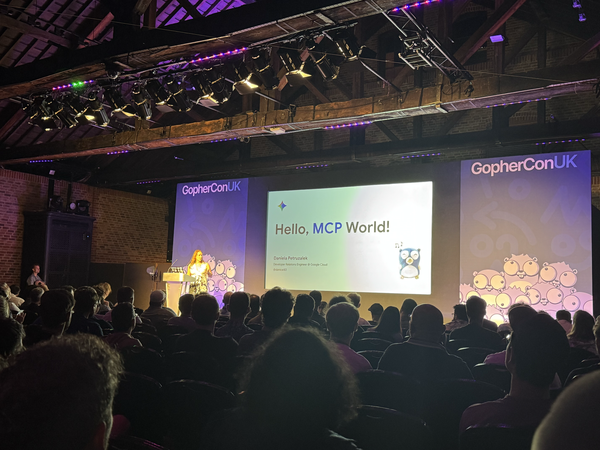
Keynote presentation at GopherCon UK 2025. An introduction to the Model Context Protocol (MCP), exploring its core concepts, architecture, and the building blocks used to create AI-enabled applications with Go.
Keynote presentation at DevFest @ Bletchley Park 2025. Exploring the intersection of Go and Generative AI, demonstrating how to build robust, production-ready AI applications using the Go ecosystem.
Hands-on workshop on building and deploying applications with the latest Gemini 2.x models, covering multimodal capabilities, tool use, and best practices for developer workflows.
Two years after their introduction, how can we use Go generics for more than just slices and maps? A deep dive into building a monads library and an Option type.
A deep dive on the slice type, starting from arrays and slice declaration syntax, slicing operations, copying, resizing and its surprising (or not) side effects.
This talk covers effective pointer usage in Go, from declaration and memory allocation (stack vs. heap) to practical use cases, including pointer vs. value receivers, unsafe package tricks, and nuances of nil pointers with interfaces.
ai & development
workflow & best practices
gemini-cli
agent-skills
vibe-coding
Learn how to use Gemini CLI’s built-in skill-creator to automatically generate, refine, and structure your own custom Agent Skills using practical examples.
ai & development
workflow & best practices
agent
ai
golang
mcp
vibe-coding
gemini-cli
Taming AI agents requires science, not just vibes. Discover how A/B testing and statistical rigor turn coding agents into a measurable engineering discipline.
ai & development
ai
python
tutorial
rag
gemini
adk
Learn how to make your AI agent completely offline. We walk through swapping the cloud model for a local Qwen 2.5 via Ollama, and building a local RAG knowledge base using SQLite and sqlite-rag to query Osquery schemas and packs.
ai & development
genai
tutorial
adk
gemini
python
fastapi
frontend
agent
Elevate your Google ADK agent with a custom, retro-style interface. This step-by-step guide shows you how to replace the standard Dev-UI using FastAPI and vanilla JavaScript, adding personality with a real-time streaming, AI-generated avatar.
ai & development
adk
gemini
vertex-ai
python
rag
tutorial
This article is a guide to creating a diagnostic agent with the Agent Development Kit (ADK). It covers the development process and explains how to use Vertex AI RAG to improve the agent’s response quality.
Based on my keynote at Gophercon UK 2025, this article is an introduction to the Model Context Protocol (MCP), exploring its core concepts, architecture, and the building blocks — Tools, Prompts, and Resources — used to create AI-enabled applications with Go.